Is Cold Emailing Illegal? The Spam-Law Myth That's Secretly Costing You Leads
My phone lit up at 4:47 a.m. with a message from my friend Renée that read, in full: "Jo. I think I just committed a federal crime. Call me the second you're up."
I was already up. I'm almost always up by 4 a.m. and usually at my desk by 4:30 a.m. This particular morning, when Renée reached out in a panic, I already had a coffee the size of a fire hydrant in one hand, and Mr. Pickles (our cat, a.k.a. 22 pounds of judgment) was staring at me from the top of my filing cabinet like he'd read the message too and was disappointed in both of us.
So let me settle something before anyone reading this starts to spiral the way Renée did. Cold email is allowed in the US when you send it the right way. Now here's where it gets confusing - "Everybody buys email lists" & "You'll get sued" can both be true at the same time, and in a minute I’ll show you exactly why.
There's a four-part way to run cold outreach that gets you clients instead of torching down your domain, and it's simpler than the fear (FEAR = False Evidence Appearing Real) makes it look. If you've ever wanted to email a stranger about your business and then talked yourself out of it because some LinkedIn genius told you it was illegal, then this article is meant for you.
One thing before we roll up our sleeves, and I mean this with my whole heart => I'm not an attorney, and nothing in this article is legal advice, period. I'm a Business Growth Strategist who has watched a lot of owners either freeze in fear or blow up their sender reputation, and I want to save you from both. So before you build a cold-outreach engine, I'd recommend having a lawyer bless your specific setup. The cost of that hour is pocket change next to a fine.
Okay. Coffee's hot. Let's go.
Renée and the 5,000 Strangers
Let me back up to how Renée got here.
Renée runs a boutique flower shop. She can make magic happen with peonies, but, like me, she’s a terrible sleeper, which, I guess, is why she's on my approved list of humans allowed to text me before sunrise.
Two days earlier, Renee had been at a Floral Distribution Conference, and some guy in a blazer with way too much nose hair sold her a spreadsheet for $25. This digital spreadsheet had five thousand contacts on it with, "Pre-qualified small business owners," he promised, with the confidence of a man who has never once been qualified for anything.
Renée got home from the Conference, loaded all 5,000 of these, “Pre-qualified” contacts into her regular business Gmail, wrote one email, and hit send to the whole list at once. Because of course she did. We've all had the 11 p.m. "I'm going to fix my pipeline TONIGHT" energy.
Then Renee made the mistake that got her texting me at 4:47 a.m. => She Googled it.
You know what happens when you Google, "is cold email legal" at midnight. The search results open up like a trapdoor, and Renée dropped straight through. Halfway down she read the phrase "up to $53,088 per email," she did the math on 5,000 emails, and calculated that she now owed the federal government roughly the GDP of a small island nation.
Renée seriously pictured herself in an orange jumpsuit explaining to a cellmate that her crime was "email marketing." By the time she texted me, she had already, in her own mind, been trialed and found guilty.
I called Renee as soon as I saw her text light up my phone. First words out of my mouth were, "Breathe!! You're not going to prison for a spreadsheet."
Here's the part that surprised her, and probably surprises you.
The Cops Aren't Coming. Your Email Provider Might.
There is no single law that says, "you may not email a stranger." People hear, "CAN-SPAM," assume the word "SPAM" means "banned," and file the whole idea under illegal. The name is doing a number on all of us.
CAN-SPAM is the US law that governs how you send commercial email, not whether you're allowed to reach out to someone you've never physically met. When you follow the rules, a cold email to a business prospect is perfectly legal in the States, no prior permission required. That's the entire reason buying contacts and running outreach is a whole industry with table-sales at industry conferences and sleezy blazer-guys.
The rules themselves are actually insultingly reasonable. Really, it all comes down to being honest about who you are and what you want. In short:
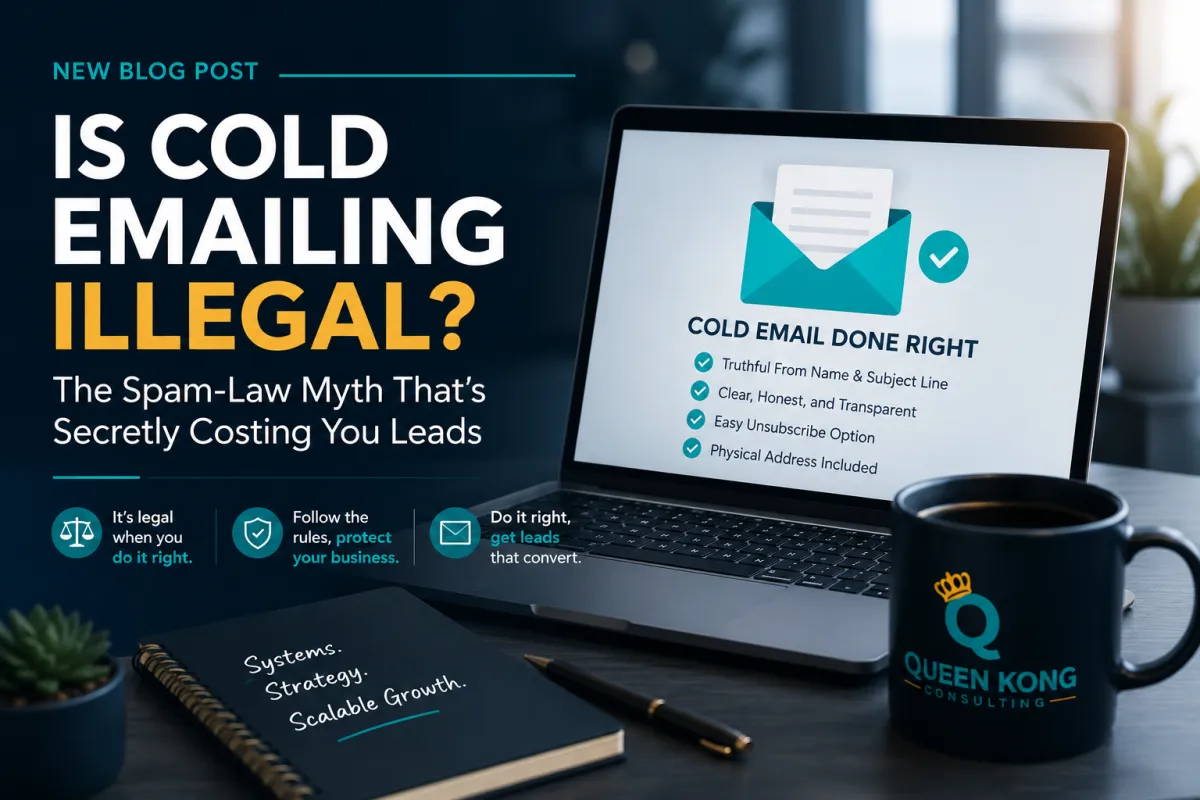
The name and email address your emails come from have to be legitimate, so your reader can tell it's you and not someone pretending to be you. For Renée, that means the email carries her name or her flower shop's name, instead of some mystery sender like "Deals4U" that nobody recognizes.
Your subject line has to describe what the email says, so nobody opens it expecting one thing and finds another. That rules out a subject line like "Re: our last chat" when you've never spoken, or "Your order shipped" when they've never bought a thing from you.
The email itself has to make clear you're selling something, so nobody mistakes it for a personal note or an order update. A simple opener works fine, something like "I run a flower shop and wanted to introduce myself."
You also must put a valid physical mailing address at the bottom (a PO box counts), and you give people a one-click way to unsubscribe that you honor within 10 business days.
That's the whole checklist, and once you build it into your template, it rides along on every email forever.
That $53,088 number Renée found? It's the maximum amount the FTC can fine you per email. Please remember that these laws and fines are intended for the people cheating on purpose => the ones faking who they are, stealing addresses off websites, or spinning up thousands of random addresses just to blast them.
Buying a tenable list and emailing it the right way is the lane you want to stay in. The scary $53,088 fine and a clean email list are two entirely different things, and the internet loves to mash them together at midnight to scare the daylights out of you.
Now, two places where the ground shifts under you, because I'd be doing you dirty if I skipped them.
Geography changes everything. If you email someone in Canada, you fall under CASL (Canada's Anti-Spam Legislation), which wants consent before you send and hands out fines that'll make your eyes water. If you email someone in the EU or the UK, GDPR (the General Data Protection Regulation) treats that person's address as personal data you need a lawful reason to hold.
Same message, different country, opposite answer.
For most US owners selling to US businesses, you're in your lane. The minute you start emailing north of the border or across the Atlantic, you need a different plan and, yes, an international attorney wouldn’t hurt.
Your email provider. Think of it this way => the law is the floor, your email provider is the ceiling, and the ceiling is what tends to fall on people. Back in 2024, Gmail and Yahoo got a lot stricter about anyone sending in bulk. They now want proof that you’re a genuine sender (with good intentions), you’re authorized to send on behalf of your URL/domain, you offer a way out for recipients (a one-click way for people to unsubscribe), and very few folks mark your emails as spam (your spam complaints should be kept under 0.3 percent). If you cross those lines, your email provider can start flagging your delivery and sending your emails to spam.
On top of that, most email tools flat-out forbid bought lists in their fine print. So you can follow every rule the government wrote and still watch your emails get buried, because Gmail saw too many spam complaints and your sending platform pulled the plug.
The thing that ends most cold email efforts is reputation, and reputation has nothing to do with a courtroom. Which brings me back to Renée, who by now had stopped hyperventilating and started asking the right question: "Okay, so how do I do this without wrecking myself?"
So How Do You Pull This Off Without Wrecking Yourself?
If you sell to other businesses, cold selling is one of the most effective systems you can rely on. Cold outreach keeps working on those slow weeks when referrals dry up, it doesn't care whether your last post flopped or nobody even saw it, and most of your competitors are either too scared to try it or too sloppy to do it right, which is the whole reason the ones who do it right lead ahead of the pack.
So here's how you send cold emails that remain lawful, stays out of the spam folder, and books calls. I run it on four letters, because it's C.O.L.D. email, and because I rarely resist a good acronym.
Run every cold campaign through C.O.L.D. => Clean list, Own a separate domain, Lawful footer, Deliverability discipline.
C is for Clean list. Your contacts need to come from a trustworthy source that can show you where the names came from, and every address gets a run through a checker before anything goes out, so you're not firing off messages to dead inboxes (too many bounces and the email gods flag you as junk). Every name on it is a business address, and every email is about their business. A clean list of 500 will out-earn a junky list of 5,000 every day of the week. Renée's blazer-guy spreadsheet went straight in the trash.
O is for Own a separate domain. Cold email should never be sent from your main company web address, the one on your website and your client emails. A second, similar-looking web address just for outreach, something close to your brand name, is what you'll send from instead. That way, if your sending ever picks up a bad reputation, your website and your client email stay squeaky clean. You'll also want three little tech settings switched on, the ones that tell Google and Yahoo you're a legit sender and not a spammer (they go by the initials SPF, DKIM, and DMARC, and your web-address provider or a tech helper can flip them on in about an hour). From there, it pays to ease in, sending a small trickle of emails for two or three weeks so the inbox warms up, before that first big batch goes out.
L is for Lawful footer. This is that CAN-SPAM checklist from earlier, built into your email template once so you never think about it again: an honest "From" line with your name and company, a subject that matches the message, your mailing address at the bottom, and a one-click way to unsubscribe that gets honored fast. The law gives you ten business days to act on an opt-out. Same-day is the classy move.
D is for Deliverability discipline. Slow is the name of the game at the start, somewhere around 30 to 50 emails a day from one inbox, and when it's time to send more, a second inbox beats flooring the gas on the first one. Sending a little at a time looks human, and that's the point. Three numbers are worth watching like a hawk: your bounces (under 2 percent), your spam complaints (under 0.1 percent), and your replies (you want those climbing). If the complaints jump, that's your cue to pause and fix the list or the wording before Google notices for you.
Do those four and cold outreach becomes a predictable pipeline feeding your business, instead of the domain-burning gamble Renée almost signed up for at a conference.
So, Renée reworked her whole cold-email outreach plan over a weekend. She trashed the spreadsheet, I showed her how to have AI generate a clean list of 300 local businesses that could use fresh flowers every week, set up her outreach address, and we wrote three emails together that sounded like a person saying hello instead of a robot reading a script. Six weeks later she'd booked nine calls and landed two large corporate accounts, the kind of office-accounts that reorders big-beautiful lobby florals every single week. And… most importantly for Renée - the federal prison remains, to this day, un-involved.
Ready to Build This? Let's Map It Out.
If you're serious about turning cold outreach into steady new business and you want it built clean from day one, grab 30 minutes with me on Zoom. This is a working session for owners ready to put a system in place. Come with your goal and your biggest sticking point, and you'll leave with a clear next step and an honest read on whether we're the right fit to build it together.
Book your 30-minute strategy sprint here: https://queenkongbiz.com/meet-with-jo-rawald
One last time, because it matters => I'm not a lawyer, and this is not legal advice. It's the field-tested view of a growth strategist who wants you sending lead-generating emails with confidence instead of hiding from your own inbox. Run your specific setup past a licensed attorney before you scale it.
With Grace, Grit & a Cat Who Judges My Sending Habits, Jo Rawald